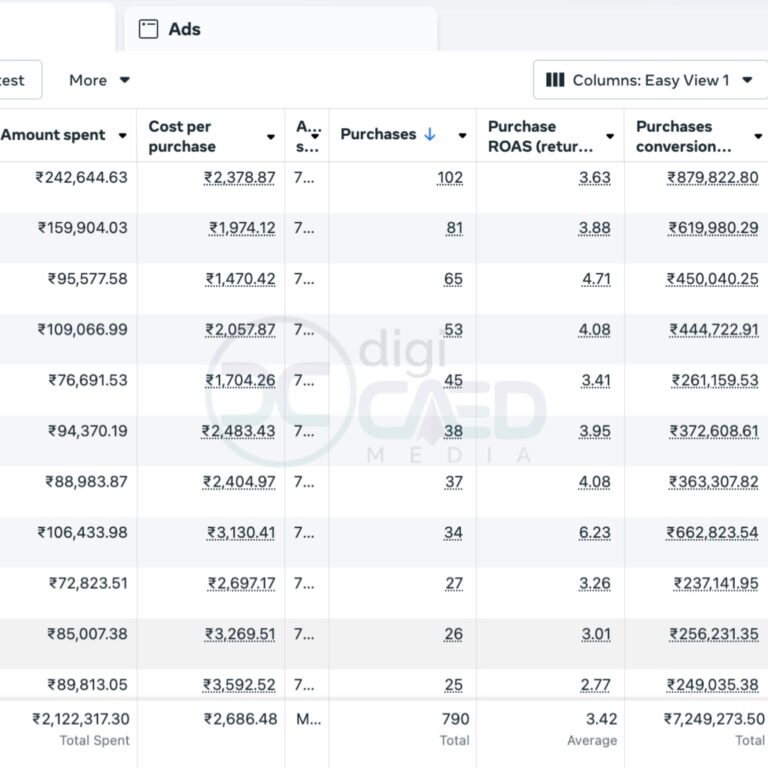
This was not a brand in trouble. They were doing ₹70,000 in revenue every single day — which is a solid number for most D2C businesses. They had a great product line, a clear customer profile, and decent traction on Meta Ads already. But despite all of that, revenue had stopped growing. Every attempt to push harder on ads would either flatline or slightly dip in returns. The daily number stayed stubbornly around ₹70K no matter what they tried.
What they needed wasn’t a rescue — they needed someone who could look at what was already working and build a real scaling strategy around it. That’s when they came to digiCAED Media.
The problem wasn’t the product or the platform. It was the absence of a structured scaling strategy — one that could grow revenue without breaking efficiency at every step.
The first thing we did was audit where the revenue was actually coming from. Not all ₹70K was equal — some campaigns were carrying the account, others were quietly draining it. We identified the top-performing watch categories and made a simple but powerful decision: put 70–80% of the budget behind what was already proven to sell.
The remaining budget went toward newer collections — not to drive immediate revenue, but to build future demand without touching the core of what was working. This 70/30 budget split is something we use across our D2C clients in fashion and accessories, and it consistently prevents the common mistake of spreading spend too thin across too many products.
Next, we rebuilt the Meta Ads structure. The previous setup lacked a clear separation between top-of-funnel (TOF), middle-of-funnel (MOF), and bottom-of-funnel (BOF) campaigns. Prospecting, warm audiences, and retargeting were all blending into each other — which is fine at low budgets, but it falls apart the moment you try to scale. We separated each stage cleanly, gave each its own objective, audience, and creative, and then systematically increased budgets as each layer proved its performance.
We also made a shift in the creative strategy — moving away from lower-priced entry-level watches and pushing creatives around the brand’s premium categories. This alone moved the average order value up significantly, which meant more revenue from every rupee of ad spend — and made the overall scaling math work much better.
On top of all of this, we worked on the website too. Scaling traffic only works if the website can handle it — small friction points that are invisible at low traffic become revenue leaks at scale. We identified a few key drop-off points and fixed them before scaling budgets further, which kept conversion rates stable as daily spend climbed.
Scaling a D2C brand isn’t about throwing more money at ads and hoping for the best. It’s about having a clear structure — knowing which products to back, how to split your funnel, and how to increase budgets in a way that doesn’t break your returns. When all of those things are in place, going from ₹70K to ₹2.5L a day in 45 days isn’t just possible — it’s predictable.
**Results achieved via Digicaed Media. Client identity kept confidential on request.**
Copyright 2026 – All Rights Reserved. Digicaed Media
digiCAED Media
Hi 👋
How may we assist you today?
Chat with us
Chat with Us